Deep Reinforcement Learning training (5 days)
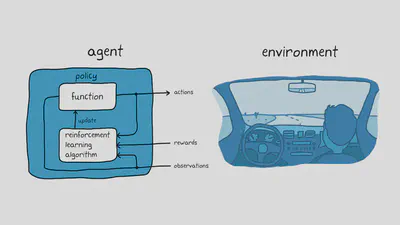
A five-day training in deep reinforcement learning that alternates theory and practice with Stable-Baselines3 and OpenAI Gym: lectures in the morning, hands-on work in the afternoon, and a final project on an environment taken from your own field.
The program below is a template; it can be adapted to your needs and the time available.
Day 1: Reinforcement learning basics
Morning
- What RL is, and how it differs from supervised and unsupervised learning
- The building blocks: agent, environment, states, actions, rewards
- Real applications: games, robotics, finance
- The vocabulary: policy, state value, action value, reward, return; Markov decision processes (MDPs)
Afternoon
- Tabular methods: Monte Carlo, temporal difference (TD), SARSA, Q-learning
- Their strengths, limits and use cases
- Hands-on: implement a simple Q-learning agent on FrozenLake (OpenAI Gym)
Day 2: OpenAI Gym environments
Morning
- The role of the environment in training an agent
- Standard environments: CartPole, MountainCar…
- Working with an environment:
env.reset(),env.step(),env.render() - Action and observation spaces
Afternoon
- Building your own environment with the Gym API
- Hands-on: a simple game with a custom reward logic
Day 3: Stable-Baselines3
Morning
- Why SB3: reliable implementations of DQN, PPO, A2C…
- Installation and setup
- Plugging a Gym environment into SB3, a first PPO run on CartPole
Afternoon
- Hands-on: tune a PPO agent on CartPole
- Callbacks to steer training: early stopping, metric logging
Day 4: Advanced algorithms
Morning: Deep Q-Network (DQN)
- From tabular methods to neural networks
- Replay buffer, target network
- Hands-on: DQN with SB3 on LunarLander
Afternoon: Actor-Critic (A2C, PPO)
- The actor-critic principle
- What PPO brings over DQN: sample efficiency, stability
- Hands-on: PPO on a continuous environment, BipedalWalker
Day 5: Deployment and a project from your field
Morning
- Saving and reloading a trained agent
- Evaluating it on episodes it never saw in training
- Integrating it into a real application: robots, simulations, games
Afternoon: final project
- A complete project on an environment taken from your field: modelling, choice of algorithm, training, tuning and evaluation
- Wrap-up: the difficulties met and where to go next